The Privacy Fallacy: Harm and Power in the Information Economy
Cambridge University Press, 2023
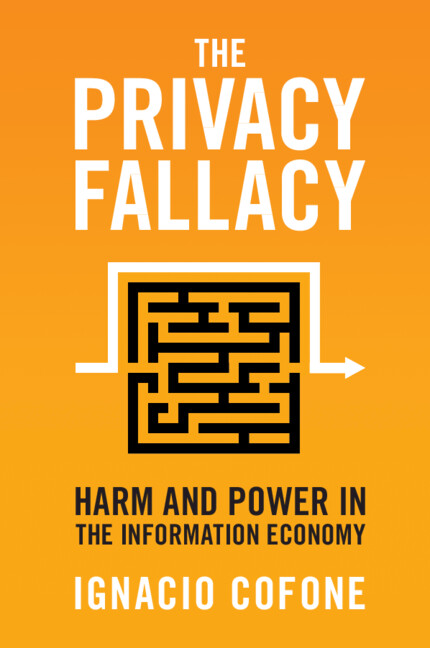
The book argues that, while privacy and data protection law are grounded in individual agreements and control, AI harms require grounding them in non-exploitation. It develops how to build accountability for individual and group harms into the information economy.
See more at Cambridge University Press or privacyfallacy.com. Available in paperback, hardcover, ebook, and audiobook (Apple Books, Audible, Amazon).
Reviews: Scott Skinner-Thompson (JOTWELL); Frank Pasquale (5.3 JLPE 631); Christopher D'Souza (22.1 CJLT 92); Donald Riccomini (71.3 STC 104).
Excerpts: The Hill Times; The Hub; ProMarket.
Dedicated symposia: Lex Electronica 2026 Special Issue (Vermeys, Zeide, Haupt, Penney, Scassa, Zeitouni); EJPLT 2025 Special Issue (Heine, Li, Palmerini, Thobani, Trouillard, Schütte & Havu); Balkinization 2024 Special Issue (Solow-Niederman, Shvartzshnaider, Aggarwal, Guggenberger, Bietti, Zeide, Kaminski).
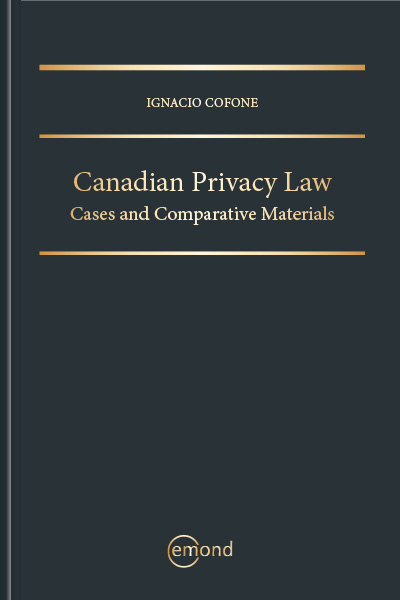
Canadian Privacy Law: Cases and Comparative Materials
Emond, 2026
The first comprehensive privacy law casebook in Canada. It integrates private law, statutory law, and the Charter alongside major international cases and instruments, including the GDPR and landmark US decisions. Four parts treat torts for digital harms, the information economy, law enforcement, and special topics.
Class Actions in Privacy Law
Routledge, 2021
Class actions are a key vehicle for holding companies and governments accountable for data harms across jurisdictions. This book examines where procedures meet the substantive challenges of privacy law, with attention to standing, evidence, certification, and damages distribution when claims are aggregated.
Review: Michael Crystal & Sabrina Chang, 17.1 CCAR 5.
The Right to be Forgotten: A Canadian and Comparative Perspective
Routledge, 2020
An examination of the right to be forgotten across legal systems, tracing how it interacts with privacy, reputation, free speech, and access to information. The book considers difficulties in importing the right from EU law into common law jurisdictions and its long-term implications for online expression and platform regulation.